


5 reflexes for dressing more eco-responsibly
Fashion is a perpetual renewal. Every season, we want to fall for that trendy little dress or that umpteenth pair of shoes, while our closets are literally overflowing. What if we came back to a little common sense? To help you, here are 5 reflexes to dress more eco-responsibly at your fingertips.
1 – Do a closet detox

"I have nothing to wear!" How many times do we repeat this phrase? And yet... nothing could be further from the truth! So before considering any new purchase, first take a look around your wardrobe. And do a nice detox.
The idea? Empty everything, as Marie Kondo, a specialist in tidying and personal development, recommends, and only re-store the clothes that you will actually wear. No more pants that are too small and that you keep when you have found your wasp waist, or that worn-out jacket that you keep "just in case". What to do with the clothes you no longer want? Give them to someone you know, drop them off in a Relais container or, for the most beautiful pieces, sell them. Once this healthy sorting is done, you will undoubtedly (re)discover forgotten pieces. Then, all you have to do is complete what you are (really) missing.
2 – Buy less, but better
To avoid making purchasing mistakes, build a wardrobe of basics that are adapted to your lifestyle and body shape. Don't forget that your body can change. That's why it's important to have a wardrobe that fits! Choose good quality pieces to avoid buying (another) white t-shirt in a few months. Also learn to read labels and buy "consciously". A Made in China shirt at a rock-bottom price is socially and ecologically suspect. The fashion industry is one of the most polluting, that's why it's important to try not to buy just anything and thus, unwittingly, endorse this system.
3 - Choose clean labels
If you want to go further, you can buy clothes that meet certain environmental and social criteria thanks to recognized labels such as Gots, European Ecolabel, Fairtrade, etc. Today's ethical fashion has nothing to do with yesterday's ethical fashion. There are lots of trendy brands, well cut, well thought out and created with beautiful materials.
4 – Wear second hand

Garage sales, specialized platforms ( Vinted , Vestiaire Collectif , etc.), vintage stores , a piece of clothing can have several lives. Of course, it takes a little longer to find "the" piece you've been looking for for a while, but in the end, what satisfaction! We treat ourselves while respecting the planet and saving money! It's all good. Recently, there have also been Instagram accounts specializing in thrift stores ( Odael_vintage , gigette-vintage , mafriperie-preloved ). The advantage? Instagrammers (fashionistas at heart) create very inspiring looks. Another option for special occasions: rent a dress that will cause a sensation ( Une robe un soir , Les cachottières ) without having to buy it and only wear it once.
5 - Encourage upcycling
After recycling, upcycling ! This green economy trend consists of valuing (by reusing differently) used products. In fashion, this gives rise to responsible capsule collections, made from fabric or leather scraps for example. Nothing is thrown away, everything is transformed!
- For example, we like Resap-Paris
- Or even The Recoverables
In the same way, by following the hashtags #upcycling or #upcyclingclothes on Instagram, we can get lots of ideas for new lives for our clothes (a man's shirt transformed into a skirt, etc.) when we know how to use a sewing machine.
Are you also getting into upcycling like Marguerite?
View this post on Instagram

Maille love, the big return of knitting
It's the new trendy attitude of fashionistas: knitting! That's good, this manual gesture of yesteryear is both relaxing and eco-responsible . To your knitting needles, girls!
We don't know if home-made knitting was born from the latest lockdowns or from the planet of young, hyper-cut designers. But one thing is certain: in 2021, knitting your own cocoon is trendy. Fashionistas, Instagram icons, swear by their knitting needles. The proof? The huge success of We are Knitters , which offers needle-in-hand kits (even for complete beginners) to create trendy knitted pieces. Not to mention the wave of "Arm Knitting" (knitting with your arms without needles), in an XXL version, ideal for blankets, hats or scarves.
What is Medknitation?
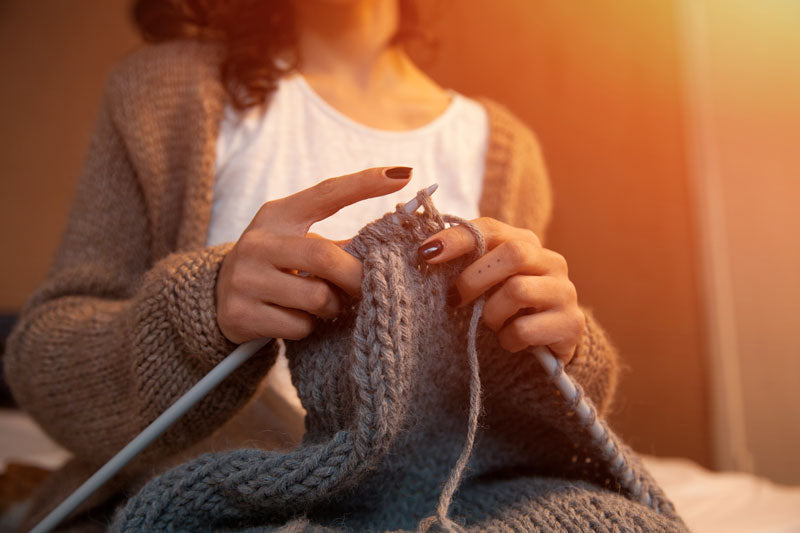
This play on words (a mix of meditation and knitting) turns this hobby, long passed down to grandmothers by the fire, into a new form of meditation. Knitting is a fun way to put your brain on pause , focus on the present moment (one purl stitch, one knit stitch) and let go of everything else.
Knitting as strong as meditation ? In any case, that's what the Anglo-Saxons think, who consider the art of knitting as a new form of yoga for the mind (and fingers, knitting is excellent against the risks of osteoarthritis!). This highly soothing manual activity could also be a surefire way to stop snacking, give up your e-cigarette or bite your nails! Not to mention that relaxing knitting can be practiced almost anywhere, even on the subway or in a waiting room! And no need to knit for hours to benefit from the relaxing effects of this activity. The regular rhythm of the needles for a few rows makes you more zen and relaxed very quickly!
Knitting, how to get started?
By ordering a minimum of materials (needles, balls of wool), you can easily follow the tutorials on YouTube. Our favorites: the channel " Tutos Tricot Françoise ", " Joueuse de pelotes " or " Les Triconautes ". On Instagram, the hashtags to follow to find a ton of ideas: #maille, #tricotaddict, #tricoteuse. At the beginning, don't complicate your life. Start with simple pieces, with a single type of stitch. Knitting is like cooking , as you go along, you will let your creativity speak!
As for needles, choose wooden or bamboo models (4 to 6 mm), slightly more expensive than plastic ones, but just as non-slip. Tip: you can get needles from an old aunt, it's the kind of material you don't throw away.
As for wool, for vegans, avoid alpaca wool (from the llama), mohair (Angora goat), cashmere (Indian goat) and Merino wool (sheep). Prefer vegetable fibers from cotton or linen. Otherwise, know that there are also many producers of ethical wool, respectful of animals and the environment (See for example De rerum natura, Lily Neige, Rosy Green Wool, Bergère de France or Fonty). Last tip: choose natural wool, without added acrylic (a petroleum derivative).
A responsible alternative
Knitting your own winter sweater or spring cardigan also means rethinking fashion in an eco-responsible way. In addition to the satisfaction of creating (the famous "I made it"), taking up knitting means positioning yourself against the grain of fast fashion . By creating your own fashion and investing in sustainable pieces that you never get tired of.

Stella McCartney, pioneer of eco-responsible fashion
For over 20 years, Stella McCartney has reconciled the irreconcilable and forged her own path, drawing many big names in fashion in her wake.
Who is she? Daughter of Paul (The Beatles) and his wife Linda, an American musician and photographer, Stella McCartney was born in 1971 in England. She grew up very simply on a farm in Sussex, where the family grew vegetables and raised sheep. She lived as a "hippie" with parents who became vegetarian activists following a stay in an ashram in India, at a time when it was not yet common. The journey of this visionary woman, the first to have combined Green fashion and Style.
A superwoman above all
Fashion, the real thing, has fascinated her since she was little and she joined the famous Saint Martins College in London (Fashion School) just after high school.
Two years after graduating, she replaced Karl Lagerfeld at Chloé as Artistic Director, and she quadrupled the house's sales.
She created her own house 4 years later (in 2001), within the Kering group. She was barely 30 years old! Two years later, she opened 3 boutiques (in London, Los Angeles and New York) where young trendy people immediately appropriated her chic and trendy brand, then distributed her clothing line in 40 countries.
This little prodigy doesn't stop there. In 2003, she created her perfume Stella with L'Oréal and her line of cosmetics Care (certified organic, paraben-free, preservative-free, silicone-free, in biodegradable packaging).
In 2008, she created a line of fine lingerie, embroidered in a retro style, in organic and biodegradable material, accessories (this is where her Falabella bag in vegetable leather was born, still a bestseller since 2010). Then a children's collection (Stella Mc McCartney kids) with the same ecological ethics, and glasses. She followed up with a 2nd perfume, a men's collection, swimsuits. And during this time, she raised her 4 children.
A subtle combination of glamour and commitment

A vegetarian like her mother and an environmental activist within PETA to defend animal rights, she was also the first to raise awareness in the fashion industry about eco-responsibility .
His activism immediately revolutionized fashion by boycotting fur and leather, but also mohair, angora and feathers, in favor of 100% natural materials and synthetics, such as neoprene or imitation leather.
It's a radical break, especially in the world of luxury where fur and leather were essential, but she explains that "50 million animals are killed just for the fashion industry and the link between food, diseases and the environment is a global problem. Even if it can be 70% more expensive, we absorb these costs in our margin and we develop our products differently, without horse, pig or fish glue."
An idealism that turns into pragmatism
Tireless, she is a fan of collaborations and imposes the same approach to eco-responsible fashion, without compromise, on the brands with which she cooperates.
She has been working for 20 years with Adidas, for whom she makes sports collections with comfortable, technical, trendy clothing. Adidas by Stella Mac McCartney, these are outfits for jogging, gymnastics, yoga, tennis, swimming, winter sports, cycling. She also dresses the English athletes for the 2012 Olympics, with such success that she does it again 4 years later for the Rio Olympics.
She also collaborates with Gap and H&M on capsule collections, and here again this icon imposes her values and her demands in terms of sustainability. A determination that goes as far as reviewing H&M labels to teach consumers to do less washing. For Target Australia, she creates 42 models in natural materials. In fact, it's a movement that she imprints everywhere she goes!
The green guarantee of major fashion groups
Within the Kering group, she sets ethical objectives which concern all of the Group's purchases, then she takes back full control of her brand in 2018.
At the same time, it is opening a new store in London, which it says is its most sustainable, thanks to its air purification process.
In 2019, she began a collaboration with LVMH and became Bernard Arnault's advisor on sustainable development.
Innovation in the service of naturalness

The same year, his show featured Natalia Vodianova, dressed in a black faux fur of plant origin and biodegradable, the Koba. His collection, more ecological than ever, is a fireworks display in terms of innovation, made from materials such as raffia, organic cotton and regenerated nylon.
In 2020, she went even further by presenting creations designed from mushroom fiber . First a bag, then clothes in a material called Mylo, made from mushroom filaments, presented as infinitely renewable. She designs her own sustainable and ethical high-tech materials and strives to reduce the environmental impact of her entire manufacturing process.
Sensual femininity, high-quality cuts, soft and practical clothing for active women, oversized sweaters, spidery blouses, flowing dresses, soft pants, in chic and sober colors... The Stella McCartney style reconciles desirability and eco-responsibility like no other.

Fashion labels, how to find your way around them?
Now, on the labels of the clothes we buy, we look for information on the manufacturing conditions, in addition to washing instructions and the place of manufacture. Some “ Clean Fashion ” labels indicate their belonging to a committed and eco-conscious fashion. To discover.
These labels meet four different criteria:
- Environmental and ecological: to signify the protection of the environment, from water pollution to the requirement for recycling of materials .
- Social: to protect workers throughout the textile production value chain. Particular emphasis is placed on fair trade, health and workers’ rights.
- Restriction of harmful substances: to indicate the harmfulness of substances used in the manufacture of textiles.
- Animal respect: to protect certain species coveted for their skin or fur.
GOTS: organic textiles

Created in 2002, it is an international label that applies to organic textiles. It is managed and issued by the Global Organic Textile Standard (GOTS).
This certification guarantees the organic status of the textile fibres used, and ensures that from the production of raw materials to the finished article, the processes involved are socially responsible and environmentally friendly. This standard covers all stages: processing, packaging, labelling, export, import and distribution of products based on natural fibres.
Level 1 or “organic” requires textiles to be made from more than 95% certified organic fibers and less than 5% from man-made or synthetic fibers.
Level 2 or “made from organic fibers” requires that these textiles be made from more than 70% certified organic fibers and less than 30% non-organic fibers with a maximum of 10% synthetic fibers.
In addition, many chemicals are banned for weaving, dyeing, bleaching, printing and for certain processing methods. The minimization of discharges and waste must be respected as well as the rules of the ILO (International Labour Organization).
Oeko-Tex: textiles without harmful substances

Created in 1992 by two research institutes in Austria and Germany, Oeko-Tex is not an ecological certification, but a guarantee of safety for health and environmental protection. It concerns both raw products and semi-finished and finished products. This certification also takes into account the different stages of processing of the product, but also the materials used in its manufacture.
This Oeko-Tex label, which checks each stage of production of a textile product, ensures that it does not contain chemicals harmful to health.
Azo dyes, formaldehyde, pentachlorophenol, cadmium, nickel, products listed in the ECHA-SVHC (European Chemical Agency, Substance of Very High Concern) and products classified as dangerous to health due to their persistent, bio-accumulative and toxic nature (PBT) are prohibited.
Fair Wear Foundation: defending textile workers

Created in 1999, the Fair Wear Foundation is an independent organization founded by the Clean Clothes Campaign, trade unions, NGOs and two business federations (manufacturers and distributors). This independent foundation works in collaboration with member companies to improve and ensure decent working conditions. This collaboration is embodied in the Fair Wear Foundation Labor Code, based on 8 standard practices supported and inspired by the conventions of the ILO (International Labor Organization) and the International Declaration of Human Rights:
- No forced labor,
- Prohibition of discrimination (race, colour, sex, trade union membership, nationality, social origin, disability),
- Ban on child labor (minimum 15 years),
- Freedom of association and the right to collective bargaining,
- Obligation to pay a decent wage,
- Controlled working hours (Working hours must comply with applicable laws and industry standards; maximum 48 hours per week with at least one day off per 7-day period),
- Safe and hygienic working environment
- Legally declared employment relationship
PETA: Protect Animals

People for the Ethical Treatment of Animals is an international non-profit organization that protects the rights and dignity of animals. PETA certification certifies that its products do not contain any animal material and that no animals have been used as guinea pigs.
Fairtrade: ensuring fair pay

Created in 1988 under the name "Max Havelaar", this label aims to ensure fair trade in economically emerging countries. Internationally recognized, it applies to food, cosmetic and textile products. Now called Fairtrade, this label guarantees cooperatives of small producers a fair and stable price for their products, as well as more sustainable commercial relations. The Fairtrade label ensures that employees are paid fairly, that there is no child labor, no discrimination and that social standards are respected. It also encourages them to practice environmental approaches and more particularly, towards agriculture that is if not organic, at least sustainable (GMOs are prohibited, but pesticides are still authorized).
Global Recycled Standard (GRS): supporting a circular economy

Created in 2008, the Global Recycled Standard label ensures that textile companies use at least 50% recycled materials in the manufacture of their new products. It also ensures that the product has not used toxic or carcinogenic substances, and that the company behind the product complies with ILO standards.
Origine France Garantie: between localism and protectionism

Established by ProFrance in 2010, this label aims to promote French industrial and artisanal know-how, raise awareness of companies producing in the region, and develop or even bring back production sectors to the country.
All stages of production must be carried out in France (cutting, assembly, finishing) and at least 50% of production costs allocated to French territory alone, in order to boost the employment pool in rural areas and raise customer awareness.
The label provides for three categories of products:
- Industrial products: they must be prepared, processed and packaged in France.
- Natural products: they must be extracted, harvested and cultivated in France (or for farm animals: born, raised and slaughtered in France).
- Processed natural products: same criteria as for industrial products with an additional clause: the main ingredients (weight greater than 8% in the total recipe, name written in the sales name and the commercial name of the product) are of French origin.
Please note: Origine France Garantie is a label, certified by an independent body and granted for a limited period to a company that is audited annually. Made In France is not a label, but a self-declared statement. The product takes its origin from the country where it underwent its last major transformation. This statement in no way guarantees that all the production stages took place in France.
There are a plethora of labels, not to mention the self-proclamations by certain manufacturers, or the greenwashing of certain fast fashion players who do not hesitate to create a capsule collection or finance an organization to display beautiful "conscious" advertising campaigns!
Please note that today no label is able to certify that a garment, said to come from Clean Fashion, is 100% eco-responsible.

Eco-responsible glasses, take a close look!
Between the glasses of major luxury brands, manufactured by giants of the sector such as Essilor, Luxottica or Safilo and the optician brands with attractive promotions, is there a place for eco-responsible glasses?
If we have already moved to slow fashion, by abandoning big name brands, we think less about ethical and ecological concerns when it comes to prescribed products, such as corrective glasses, or even when we want to treat ourselves to a pair of sunglasses, a fashion accessory that we match to our look.
When we know that more than seven out of ten French people wear glasses – and three out of four adults renew them at least every three years – and that the majority of these glasses are made of plastic (injected plastic, cellulose acetate or Grilamid) or made of a mixture of metals (titanium, aluminum, stainless steel, cobalt, nickel) and, above all, are manufactured in Asia, an eco-responsible approach seems desirable.
All the more so since, in nature, a classic pair of glasses takes more than 400 years to degrade, leaving behind pollutants.
From frames made from recycled or biodegradable materials to environmentally conscious "eco-opticians" and the second-hand eyewear market, alternatives exist, but, as always, they require a proactive approach.
Frames made from biodegradable materials
In order to respect the environment , more and more new brands are using biodegradable natural materials to make their eyeglass frames. These materials include FSC-certified French wood (i.e. from well-managed forests) and bio-acetate. Some frames are also made of bamboo or cork, following ecological manufacturing processes.
Wood, a natural material

Having appeared around ten years ago, in France in particular with the Waiting for the sun brand, wooden glasses are all the rage and are gaining ground on opticians' shelves. An eminently natural material, provided that this wood is produced locally and is not treated with polluting substances. Among the French brands at the forefront of this material are: Mou Sunglasses , glasses made from Basque wood or In'bô in Lorraine wood; the Ardéchoise Woodlun's , using oak, chestnut, ash, beech with finishes in cherry, walnut, maple... and some precious woods - zebrano, ebony and amaranth -, from recycling; or Shelter in Annecy, which recovers dead wood and shapes sunglasses in its workshop. The English brand Bambooka uses a species of giant bamboo, which gives light and solid frames and donates its profits to People Empowered Preserved Earth which supports and teaches permaculture and hygiene. And Hemp , as its name suggests, uses hemp.
Bio-acetate and bioplastics
Since the early 2010s, bioplastics created from corn, castor oil or algae have been used in the manufacture of certain glasses. Natural PX is a polymer composed of 65% castor oil. But among these new materials, bio-acetate is certainly the most widespread. This bio-sourced polymer, called M49 and marketed since 2013 by Mazzucchelli, gives an eco-responsible thermoplastic material, is composed of cotton flake powder and wood cellulose, mixed with a plasticizer of natural origin. 100% biodegradable and recyclable, without phthalates, it is capable of degrading naturally in 115 days once placed in the ground. Moreover, we now find at Grand Optical , EcouterVoir (under the Juste brand) and Générale d'optique (Go Green) models in bio-acetate. At Afflelou , the Magic 13 is made of G850, based on castor oil (with lenses in BD8, a recyclable material).


Since its creation in 2014, Moken , created and based in Hossegor, has offered biodegradable, organic and biosourced glasses, originally designed from cork, wood and stone. The brand has recently ventured into bioplastics, made from plants, to build ethical glasses. Waiting for the sun has also developed a new material, bois2, a recyclable and biodegradable bioplastic, made from recycled wood from the offcuts of their wooden frames.
Frames made from recycled materials
In a concern for zero waste , many eyewear manufacturers have started manufacturing frames from recycled materials, with diverse and often surprising origins: wood from furniture manufacturing, strips of old skateboards, and even old oak barrels thus become the raw material for the arms and rims of glasses. Other highly technical processes also make it possible to recover food waste from catering by creating eyeglass frames from compressed coffee grounds or crushed shells, or waste collected from the seabed.
Recycled natural materials
Some frames are made from compressed dried coffee grounds ( Ochis Coffee ). The sea is also a good supplier: the Naoned brand makes its glasses in Brittany and offers models made from seaweed. As for Friendly Frenchy , these Bretons collect empty shells and crustacean shells from restaurants or the food industry, crush them to integrate them into the production of solid plates from which the glasses are cut. Another of their collections is made from grape seeds. The production is 100% Made in France.
Recycling and Upcycling


Many brands, like the Danish Monkeyglasses - which also makes bioacetate frames - use recycled material for their metal collections.
Some frames, quite original, are made from recycled everyday objects. Barrels, furniture, and even end-of-life skateboards (7 Plis) are thus recovered and transformed into recycled frames.
Vinylize in France and Spexwax in San Diego make their glasses from old, unplayable vinyl records. The latter offer cases made from the cover of the vinyl album used.
Yuma Labs uses 3D printing for its glasses made from recycled fridges, recycled soda bottles (from Europe) and even recycled dashboards (from the Netherlands)!
SeatoSee was created by a Dutchman living in Barcelona. He uses waste (bottles, but especially fishing nets) collected and recycled through a collaboration with thousands of Spanish, French and West African fishermen, raising awareness, and has his glasses manufactured entirely in Italy.
In addition to the raw material of the frames, there is the assembly. Thus, since most hinges are made in China, some eyewear manufacturers make frames by hand and without screws, in order to optimize their biodegradation. And in order to have an eco-responsible approach to the end, they use varnishes and food colorings to finalize their products.
Finally, in order to eliminate plastic, some pack the frames, when they are sent to the optician, in recycled and recyclable paper bags. And make their cases out of cardboard or recycled materials.
Vintage Glasses

Some brands and opticians have undertaken to give glasses a second life. By hunting through flea markets for glasses from the 50s or 60s, by collecting from opticians or as part of campaigns, then reconditioning them, either to resell them in their specialist shops or to offer them to the general public with low incomes or no income at all, like the Lilloises de Lunettes de Zac .
Photo: © Zac's Glasses
Eyeglass lenses and sustainable development
While frames allow for inventiveness in the use of materials, corrective lenses leave fewer alternatives, at least for now. The lenses are in fact either organic (a synthetic material), or polycarbonate, an unbreakable and lightweight material, or mineral. While the latter are very easy to recycle, they are used less and less because they are too heavy and break easily. But these mineral lenses seem to be making a slight comeback for sunglasses, in particular, because they scratch much less.
More ecological processes
While the possibilities are fewer in terms of materials, many glassmakers are implementing manufacturing processes to limit the impact of their production on the environment . Some French glassmakers are working to produce ecological glasses by recycling and reusing the water used for cutting the glasses, replacing certain consumables with washable products, eliminating the use of lead and innovating in 3D printing.
Biodegradable optical glasses?
Optical lenses can also be biodegradable. Some manufacturers make lenses with a bioplastic derived from castor oil. They can be transparent or even tinted to serve as sun protection and would degrade in less than 4 years in nature.
Responsible opticians
Opticians are also the ones who are shaking up the market. In 2012, one of the first eco-responsible opticians, Sébastien Bétend, created an optical shop in Bron, near the Swiss border, which only sold eco-responsible brands that were manufactured (and not just assembled) in France. He ended up creating his own brand, OpSB , which offers “local, ethical and ecological” glasses made from 100% recyclable and 80% biodegradable materials. Several opticians in Paris and other major cities are also making this choice.

The Jimmy Fairly chain also offers trendy glasses, with an ethical positioning with its "buy one, give one" policy. For each pair purchased, a new pair of glasses is given to a person in need through charities.
Organizing the end of life of glasses
"Classic" glasses are not recyclable: in its "Sorting Guide", Ademe indicates that they must be thrown in the household waste bin, to be incinerated or buried. Wooden glasses are no exception to this rule because of the glue that binds the sheets of wood. According to an Opinionway study carried out for Atol, one hundred million pairs of glasses are sleeping in our drawers in France. According to the Krys Foundation , ten million pairs that are still usable are thrown away every year in Europe and the United States. But, if they are in good condition, the glasses can be returned to opticians who offer them and who will redistribute them to associations. Krys, Vision Plus and Lynx Optique are part of the Krys Group Foundation, Jimmy Fairly takes back his customers' glasses. The Lions Clubs and Lunettes sans frontières also organize collections and redistributions so that the glasses participate in the circular economy.
The world of optics is booming. So much so that a passionate and committed optician has created a label governed by 8 criteria within a charter of commitment, the “ Optic for good ” label. Still in its infancy, with 11 brands and 9 opticians, this initiative – the labels being proof – should quickly develop.

What ethical fashion for children?
Green brands for children, more committed and respectful of the planet, are experiencing spectacular growth. A selection of favorites to concoct a more eco-friendly wardrobe for them. To have style while being ethical !
Fashion is being criticized for the use of harmful substances that can have an impact on the ecosystem and on organisms , as they are impregnated with chemicals (heavy metals, endocrine disruptors, allergenic dyes, etc.). As a result, mothers are increasingly trying to reconcile the useful (dressing children with brands that respect their skin and the environment) with the pleasant (following trends).
If you are looking for eco-friendly clothes for your little ones, here is a selection of five brands that tick all the boxes: short circuits, Made in France or fair trade, noble materials, labels… All while adapting to the trend. Who will be the most beautiful at recess? Also follow Mathilde Lepage , the Instagrammer who is shaking up the fashion world, some of her advice is super smart!
The Little Things


A brand for children and babies based in Montpellier.
Their credo? Affordable chic, in natural materials such as organic cotton or Merino wool for winter, Oeko-Tex certified. Manufacturing is European to limit the carbon footprint.
We like : unsold items are donated to an association. Nothing is wasted.
The cat's tail

This Bordeaux brand offers organic fair trade products in casual and fully labeled collections. The entire clothing production chain is certified, from cotton cultivation to garment manufacturing (GOTS, FLO and SA8000).
We like : eco-friendly too, with biodegradable packaging.
Photo: © The cat's tail
Daddy

The brand has opted for 100% French manufacturing in an approach that is both eco-responsible and civic-minded. The sweatshirts come from Marseille, the t-shirts and bodysuits from Saint-Pouange. All in organic cotton.
We like : the clothes offered are unisex and non-gendered
Photo: © Papate
Life imprisonment

Here, no collections but timeless pieces (super sturdy pants, basic leggings, t-shirts in all colors, etc.).
The idea? Create a perfect wardrobe for the whole year. The suppliers are European, the materials are of super quality (it has to last a little while!) and responsible (with GOTS certification for cotton).
We like : the brand's "second life" commitment. Perpète takes back all clothes (too small and/or damaged) in exchange for vouchers. Direction upcycling or second hand.
Animal Kids

Super cute animal-themed clothes! All in certified organic cotton (GOTS) with the guarantee of no chemicals in the design of the clothes. The philosophy of this pretty French brand? Dress the little ones and raise awareness among the older ones about animals that are in danger of extinction or in difficulty on our planet. Who is not sensitive to the fate of African hippos, or pandas? Not to mention that of Jules the narwhal or Maël the kangaroo? Because all the animals have their little name... And the prices are very reasonable.
We like : Animal Kids donates 15% of the price excluding tax of each sale to the NGO or action of your choice.
Photo: © Animal Kids
Mathilde Lepage’s 5 tips
Instagrammer @makemyclothesgreatagain and author of Changeons de mode (Ed. Eyrolles).

- Rely on labels based on the criteria you set for yourself. For example, textile labels such as Gots or Oeko-Text guarantee an ecological and socially responsible production method.
- Choose materials that are non-irritating to the skin. Avoid synthetic materials (polyester, acrylic) as much as possible, and opt for natural materials such as cotton, preferably organic. The only downside: the cost remains higher.
- Try second-hand . It's a good way to dress the little ones (who grow up quickly) while avoiding accentuating the production-pollution-overconsumption spiral. Especially since second-hand clothes (already worn, already washed, etc.) contain fewer toxic microfibers. Some online second-hand brands for children to follow: Fashionizy, Kids O'clock , SoKyoot, Beebs , By Bambou , TyDressing , Little Kids , Patatam .
- Stay connected to the clearance Marketplaces of ethical brands, like WILD or Dream Act, to find some brands of new products.
- Think about renting! For example, in Lille, “ Les p'tits louent ” (but there are some in many cities) or thanks to the exchange brand “ Greendy Pact ”.

Ethical sneakers: a big step towards Clean
We all have a pair of sneakers, or even several! Except that this basic of our shoe wardrobes - sometimes cult - is often far from virtuous. Raw materials, manufacturing conditions, end of life, so many problems to solve so that our sneakers are clean .
In France, more than one pair of shoes purchased in two (72 million) is a pair of sneakers, or more precisely sneakers, these athleisure shoes, which are no longer used for sports. Their sales have been increasing steadily (5% per year) worldwide since the 1980s, when this fashion took off with the launch of the Nike Air Jordan One, and the signing of the historic partnership between basketball star Michael Jordan and Nike. Globally, sales represented $82 billion in 2019, for nearly a billion pairs produced. The global sneaker market is expected to reach an annual growth rate of 7% between 2020 and 2024.
The problem: the vast majority of these shoes are still produced with polluting materials, in countries where the workforce is generally underpaid and where working conditions are often deplorable. Nevertheless, progress is being made. Spotlight on these cult shoes that are on our feet.
A social phenomenon
The sneaker has long ceased to be a sports shoe. A symbol of streetwear, it is the basic shoe for those under twenty who only wear it. And while we may want to buy our jeans at Zara or H&M, there is no way some people will not wear sneakers with a comma, 3 stripes or a feline. Each new shoe is launched with marketing plans worthy of perfumes and muses in prestigious "collabs". With big names like Kanye West or Rihanna, the sneaker has become a societal phenomenon, a social marker, a sign of generational belonging. And it affects all generations and social categories. In 2019, they even represented 90% of shoe sales at Balenciaga, 70% at Pierre Hardy and Gucci, and 40% at Louis Vuitton and Hermès.
If out of snobbery, we buy our sneakers at Lidl, it is because it is an ultra-ephemeral edition for which we will have queued for 3 hours, and that we can resell 100 times its purchase price on the Internet! A sneaker exchange was even created in 2016, StockX, where the models most sought after by "sneakerheads" are resold at a high price.
In short, the sneaker has far exceeded its primary function. It is a mass consumption object, sold much more expensively than its cost price. And that is the problem: the mass-market sneaker is not very responsible.
Not eco-friendly at all

The sneaker has long symbolized the failings of globalized capitalism. Designed in Western countries, produced at low cost in Asia, launched with huge marketing and advertising investments, it sells at high prices, adding value to the brand and its stock price.
The result: sneakers have one of the largest carbon footprints of any item of clothing we wear.
According to a study conducted by MIT (Massachusetts Institute of Technology), a pair of classic running shoes generates approximately 13.6 kilos of CO2 emissions. Most of these emissions are due to manufacturing. Among other things, because most of a sneaker is made of plastic, but also polyester, thermoplastic polyurethane (TPU), or ethylene-vinyl acetate (EVA), all petroleum derivatives. But also because the entire production chain reproduces the excesses of fast fashion ( pollution , poor working conditions, etc.).
Awareness
Even though we are aware of this negative impact, we continue to buy these products because their level of technicality and aesthetics guarantee comfort and stability (essential for a high-performance shoe) and they are always in the latest fashion.
Fortunately, changes are on the horizon. The study by the start-up Retviews, published in 2020, confirms that protecting the environment and combating waste are at the heart of concerns due to the pandemic, especially among Generation Z, the biggest consumers of sneakers. 90% of them are ready to change the way they consume, so much so that the big brands (and new ones) in this sector have already started a shift by reviewing their development and production, with more transparency and ethics to satisfy these young consumers.
The alternative offer is expanding
For the past ten years, new brands have been created around the world, which claim more virtuous, more ethical and greener manufacturing.
Veja, the pioneer

Veja, a Franco-Brazilian brand, has been offering fair-trade and organic sneakers since 2005, with more expensive but more durable materials, made by better-paid workers. Veja has set up its factory in Brazil according to the principles of fair trade, using as many sustainable materials as possible: wild rubber, organic cotton or leather tanned with plant materials. For distribution, in Bonneuil-sur-Marne, Veja entrusts its logistics to a reintegration company. Confidential at its launch, adopted by Marion Cotillard in the early 2010s, it invaded social networks when Meghan Markle and Emmanuel Macron wore them. Condor by Veja created at the end of 2019 was “the world's first post-oil running shoe”. Despite everything, the brand acknowledges on its website that it still has limits to the 100% ethical and organic manufacturing of its shoes (rivets, dyes, etc.). After Veja, many new brands have emerged. For example, in Great Britain, Vivobarefoot, the minimalist footwear company is aiming for complete circularity with its Primus Lite II Bio model which is made up of more than 30% natural materials derived from plants, such as corn, natural rubber, and algae.
150 new brands in France


In France, 150 new brands have entered the sneaker market over the last five years, highlighting the themes of eco-responsibility, ethics and/or ecological impact.
The 1083 label, which has already distinguished itself with responsible jeans, created the 903 sneaker which became entirely vegan in 2020. We can also mention Sessile (eco-designed, repairable and made in France), Caruus (a model in recycled and upcycled linen made in France), Clae (in cactus leather).
Wilo is launching a “zero plastic” sneaker, 100% plant-based and biodegradable, made in France. At Ector, the sneakers are entirely knitted from recycled plastic bottles, between Saint-Etienne and Romans. Also worth noting are ethical initiatives with partnerships for development in certain countries: Panafrica with Morocco, Burkina Faso and the Ivory Coast, or Perus, which manufactures in an artisanal way in Peru within a fair trade framework.
TBS (Eram group) recently presented RE-Source, an infinitely recyclable model. And the famous Bensimon tennis shoe has just released its eco-designed version, called B-79. Structured around two models, the range made in Spain features outsoles made of recycled natural rubber, insoles made of recycled cork, while the uppers of the shoes are made of organic cotton.
Recycled, upcycled , made from sustainable raw materials or recycled plastics, all options are possible, and when they are not made in France, their production is carried out under ethical conditions.
Major equipment manufacturers are getting involved
These emerging brands, the major campaigns of the 1990s/2000s and the desire of buyers to consume more responsibly have pushed major brands to review their practices. All have taken more ecological manufacturing approaches and some (Nike, Adidas) have gone so far as to position themselves against the forced labor of Uighurs, at the risk of being boycotted in China.
As a reminder, Nike, which hired Colin Kaepernick in 2018, an American football player who became a political symbol of the Black Lives Matter movement, for the 30th anniversary campaign of its slogan "Just Do It", triggered the ire of white supremacists and Trumpists. The fact remains that, according to the Collectif Ethique sur l'étiquette - which is for social progress Against the violation of human rights at work - the cost of labor would only represent $3 on a sneaker sold for $80!
New manufacturing technologies


Leading brands are now keen to reconcile technology and eco-responsibility:
- Nike Flyknit technology—which uses recycled polyester from plastic bottles to create a high-precision knit—is said to create 60% less waste than traditional manufacturing and has avoided 1.5 million kilos of waste. Nike has made the circular economy one of its main concerns. In addition to the Space Hippie sneakers made from recycled plastic to reduce its amount of waste, the brand with the comma has decided to re-sell lightly worn pairs, and to offer shoes with a slight manufacturing defect on the shelves. Called Nike Refurbished , this new service is already available in a few American stores and will soon be available in fifteen Nike Stores in total. Nike is also planning to release a Vegan line called “Better” in summer 2021, including Air Force models.
- Le Coq Sportif has unveiled two 100% plant-based models , made from grape marc (unused residue after extraction of juice for the production of wine or grappa). Produced in Portugal from materials sourced in Italy, the inner sole is made of cork, the outer sole is made of rubber and the laces are made of cotton. Two models are thus offered: the Nérée, with a retro running look, and the Gaïa, a reminder of the brand's Court models.
- Adidas, the brand with the 3 stripes, had already launched more ecological production processes for its sneakers in 2015 with a model designed with Parley For The Ocean, from recycled marine plastic waste (15 million pairs sold in 2020). The German manufacturer launched the Stan Smith Primegreen in early 2021, which has a 50% recycled composition, made of a Primegreen upper, a recycled rubber sole and laces made of recycled polyester and rubber. The birth of Stan Smith Mylo, made from mushroom leather, has been announced. Since 2019, the Adidas brand has also launched the Futurecraft.loop , a high-performance running shoe, made of thermoplastic polyurethane - a plastic considered sustainable - and without glue, 100% recycled and recyclable, which it hopes to make infinitely recyclable.
- Reebok, which belongs to the Adidas group, unveiled a pair of vegan running shoes at the end of 2019, made from castor beans and natural rubber for the sole, algae foam for the lining and eucalyptus wood for the upper of its shoe. This sports brand already had in its products a pair of eco-friendly sneakers made from organic cotton and corn for the sole.
- As for Yeezy, the streetwear label run by Kanye West, its sneakers called Clog are entirely biodegradable, made from algae foam.
Ethical and ecological progress
Following the major campaigns of the 1990s, which revealed the undignified working conditions of Nike subcontractors in Indonesia in particular, the firm introduced a Labor Code in 1992, revised in 1998 and 2001. This code prohibits forced labor and child labor, ensures workers a minimum wage or the standard wage in the industry and the right to free association and collective bargaining in a safe and healthy work environment. American NGOs of international scope are working to effectively verify, on the ground, the working conditions in the factories in question, such as the Fair Labor Association (FLA). The fact remains that the major equipment manufacturers produce massively in Southeast Asia. And for the past ten years, faced with the increase in labor costs, they have largely relocated their production plants to Vietnam, Cambodia and Indonesia.
Since September 2019, Nike has also implemented the Move to Zero program, aiming for zero carbon emissions and zero waste . To achieve this, the company intends to equip all its sites with renewable energy by 2025 and reduce its greenhouse gas emissions by 30%.
So, some brands choose fair trade, others recycled raw materials, and still others new upcycled and vegan raw materials. Who should we favor?
Is a brand eco-responsible when it manufactures recycled materials, but in factories with questionable working conditions?
Sneaker manufacturing is still far from perfect, but there is momentum here too. There remains another crucial point: the Capital magazine broadcast at the end of March 2021 on M6 mentioned 600 million pairs thrown away per year in France. And 90% of these shoes are buried or incinerated. If production is becoming more and more responsible, it is up to consumers to do the same...

Linen, trendy, multi-talented and eco-responsible
Its popularity rating is booming. More and more brands have made it the star of their collections in recent seasons. Even the cotton specialist, Petit Bateau, has dedicated a line to it. It is also found in certain cosmetic products! It must be said that linen has many good points.
In Clean Fashion (ethical fashion), table linen or bed linen, linen is all the rage. Although it still only represents 2.4% of the world's production of natural fibres (75% for cotton), 80% of it is produced in Europe and France is the world's leading producer. Cock-a-doodle-doo!
This is why many brands that now favor Made in France are putting it back in the spotlight. And are working to reestablish a sector that is still too delocalized.
Flax, an ecological plant
Flax is a herbaceous plant with pretty blue flowers. Its natural fibers are found in its stem and not in its flowers. It is the oldest natural material in the world. At the time of the Pharaohs, bodies were embalmed in strips of flax. Today, it is mainly cultivated for its textile fibers and its oil seeds.
- Almost zero environmental impact
Flax cultivation requires little water and pesticides. The plant grows naturally thanks to the heat of the sun and rainwater, so it does not require any irrigation, unlike cotton . It is also a very resistant plant fiber that requires almost no fertilizer or even pesticides. In addition, flax is a carbon sink: each hectare of flax retains 3.7 tons of CO2 each year.
Flax production is also ecological. Each of the stages of processing (harvesting, retting, scutching, combing, spinning, weaving, manufacturing) is done mechanically and without chemical solvents. One hectare of flax produces on average 1,300 kilos of long scutched fibres, in which the straw and seed are separated. Finally, if the original fibre has not been mixed with synthetic fibres or chemically dyed, it is completely biodegradable.
- Zero waste
Another advantage is that all parts of the plant are used. Its stems become fibers with multiple uses. Its seeds are collected either to be sown again or to make omega 3-rich cooking oils or paints.
Linen, a textile with multiple qualities
– Linen is renowned for its incredible resistance (2 to 3 times greater than that of cotton).
Strong, light and flexible at the same time, linen fiber has a very long lifespan. Although it appears rigid at first glance, it softens over time with use and washing. Linen owes this property to the pectins – from the sugar family – that make up the walls of its fibers. They help structure and hold the fibers together. This is also what makes it hydrophilic, i.e. very absorbent: linen can retain 20% of its weight in moisture.
This particularity explains its thermoregulatory, hypoallergenic and antibacterial properties. As a result, linen clothing is particularly pleasant to wear in hot weather. Lightweight, it keeps the body at an ideal temperature while having a super absorption power. It is also a very good insulator, thanks to its hollow fiber which retains both heat and freshness.
- And its many outlets

Flax has multiple uses. Its fine fibers are used for clothing, household linen and upholstery fabric, with an image of high-end nobility. Thicker flax fibers are used as insulating material, to absorb vibrations or are introduced into composite materials to strengthen them. Flax is also used in the automotive sector (components and insulation), hi-tech (headphones, chains) and sports (skis, bicycles, tennis rackets, surfboards, etc.). Flax is also used in the manufacture of banknotes or cigarette paper.
France, the world's leading producer and exporter of flax
- A predominantly European production

Flax grows exclusively in temperate and humid climates. And in fact, 85% of the scutched flax produced worldwide comes from a coastal strip extending from Caen to Amsterdam, following the coastlines of Belgium, the Netherlands and France. In France, the world's leading producer with 140,000 hectares of cultivation, flax is grown in Seine-Maritime, in the Nord, Pas de Calais, Somme, Oise, Eure and Calvados. France is renowned for its high-quality flax with fine and strong fibres. The European flax industry today consists of 10,000 companies spread across 14 countries.
- Exported production
The problem: 95% of French production is exported, mainly to China or India, to be processed there. Which obviously increases the carbon footprint of this very ecological material. On the other side of the world, workers in Chinese and Indian factories spin, weave and make clothes that are then resold in France, Italy or Belgium, but also in Japan, which is fond of this fiber, and even today in China. France therefore buys clothes made with the linen that it sold a few months earlier.
In addition, some manufacturers use chemicals during the linen processing phases (dyeing, chemical treatment, etc.) that alter the ecological character and quality of the natural linen fiber. Clothes crease, deteriorate more quickly and are less durable. Certainly, some labels, such as “Master of linen”, guarantee 100% European linen, from the field to the thread to the fabric.
Spinning mills for 100% French linen


This aberration has alerted certain brands that are fans of Made In France.
A collective called Linpossible was thus created, led by the committed brands Splice and 1083 , followed by Le Slip Français , the LCBIO association (Lin et Chanvre Bio), the Alsatian textile company Velcorex , the Romans-sur-Isère company Tissage de France, the specialist cooperative Terre de Lin and one of the last European linen spinners, Safilin .
The collective has been working for years to have spinning mills reopen in France, the last missing link in a supply chain for linen clothing made 100% in France. Indeed, Safilin, the last national spinning mill, had to close its Hauts-de-France site in 2005 to install its machines in Poland. Safilin will therefore reopen a spinning mill in 2022 with 14 spinning frames, including twelve dedicated to “wet” production (used mainly for textile manufacturing) and two “dry” spinning mills (thicker yarn, particularly intended for decoration, but also for thick pieces), to generate 350 tons of yarn per year.
Other projects have also emerged. In 2021, the Alsatian company Velcorex set up a dry spinning site to produce linen denim in particular. And Natup, which already owns a flax combing plant (42 employees), is due to set up a spinning mill with a production capacity of 250 tonnes of flax yarn per year with 25 employees in early 2022 in Saint-Martin-du-Tilleul (Normandy). However, this will come at a cost: the Linpossible collective estimates that the price of a kilo of flax spun in France will be around double that of flax spun abroad.
Linen, an ecological material and French pride, is now exported all over the world, but through spinning mills that are at best European, often Chinese. This increases its ecological footprint and sometimes deteriorates its quality. Fortunately, the challenge of recreating a 100% French sector seems to have been met, but to produce more luxurious and therefore more expensive linen.

Viscose, clean or not clean?
Viscose is labeled on our clothes as a natural material. But in reality, it is a process of transforming a natural material, and not a very clean process at that !
Viscose: an artificial material of natural origin
Viscose is a material derived from wood, which has its advantages but also its disadvantages.
Derived from wood
It is called a natural material because it is obtained from a natural fiber. In fact, viscose is derived from wood cellulose (bamboo, corn, soy, beech or eucalyptus). The term viscose comes from the way the fiber is made, a viscous organic liquid used to make both rayon and cellophane. Originally, it was called artificial silk because this transformation process was invented in 1884 by a Frenchman, Count Hilaire de Chardonnet, who was looking for a material similar to silk, which was then very fashionable but expensive (the term rayon appeared in 1924). It was an immediate success. Viscose did not face competition from synthetic fibers, derived from petroleum, until 1938.
Yet, even today, viscose is still widely used in the textile industry. It is estimated that 99 million tons of wood pulp are used each year worldwide to produce viscose!
An “easy” subject

The artificial fibers obtained – in addition to their low cost – give a fluid, shiny, soft, fine, sometimes tight-fitting and pleasant to wear fabric. In addition, viscose fabrics are very resistant and fix the color well. They resist successive washes better than natural fibers, which can fade.
But viscose also has its limitations. Anyone who has tried to wash a garment made from fabric that has not been pre-washed knows that viscose can shrink in the wash, wrinkle easily, and deteriorate when exposed to light. In addition, its fibers do not absorb moisture or retain heat. They are therefore poorly suited for winter clothing and technical sportswear.
A chemical, polluting and wasteful manufacturing process
Presented as sustainable and biodegradable ecological alternatives to cotton and polyester, due to their natural origin, viscose is promising, but its manufacture has effects on the environment.
They promote deforestation

To provide the wood needed to produce these artificial materials (5 million tons), 70 million trees are cut down each year just to meet the demand of the textile industry. In fact, it takes about 1 kg of natural fibers to obtain 400 g of regenerated viscose fibers. And thousands of hectares of tropical forests are cut down to plant trees specifically used for the production of rayon. In addition, farmers practice monoculture which destroys biodiversity because it always draws the same nutrients from the soil and depletes it, forcing farmers to use pesticides and fertilizers.
A polluting transformation
The viscose process is very water-intensive during its manufacture: 400 to 11,000 litres of water are consumed to produce 1 kg of viscose. The wood pulp is dissolved in caustic soda baths to obtain a flaky mass which is mixed with carbon disulphide – toxic and flammable – to become a paste, then drawn into threads and woven. Finally, the filaments obtained are cooled in a bath of sulphates and sulphuric acid which allow the fibres to be fixed. In developing countries where viscose is manufactured, there is no reprocessing of chemical waste, so it is released into nature and rivers and pollutes ecosystems.
In addition, these aggressive chemicals remain partly present in fabrics made from viscose despite treatments (dyeing, printing, finishing, washing, etc.). Viscose is then toxic for the consumer after having been toxic for the workforce that made it.
There are ethical and ecological viscose
Despite this polluting manufacturing process , viscose is still widely used, including by fashion brands that claim to be ethical and eco-responsible .
From sustainable forests
Some viscose is made from bamboo or eucalyptus pulp from sustainably managed forests, which have the PEFE-FSE or FSC certificate. This certifies that the source of plant material is respectful of the environment and human labor. Stella McCartney uses viscose from sustainable Swedish forests.
A cleaner process
For the Changing Markets Foundation, designing cleaner viscose is not impossible. The organisation has therefore drawn up a roadmap for companies in the sector, highlighting the different ways to ensure a safer supply chain that respects people and the planet.
More and more fast fashion brands are committing to this path by signing this roadmap.
Lyocell, clean viscose
Viscose is increasingly being manufactured using the Lyocell (or Tencel) transformation process. This uses N-Methlymorpholine N-oxide (NMMO) as a solvent, which has the particularity of also being recyclable. The process thus operates in a quasi-closed circuit. In addition, the water is recovered and the plants providing the cellulose come from sustainably managed forests. Finally, Lyocell fibres are biodegradable.
A survey published on January 10, 2019, commissioned by the Changing Markets Foundation and the Clean Clothes Campaign from the Ipsos-Mori agency, revealed that 75% of French consumers think that clothing brands should provide information on their environmental commitments and that 72% of French people approve of the idea that clothing brands should be required to provide information on their viscose manufacturers and their impact on the environment. Despite efforts, we are still far from there!

Can we reconcile luxury and clean?
If luxury and sustainable development seem totally incompatible at first glance, the reality is more complex. Synonymous with quality and sustainable objects, the luxury sector must set an example, under pressure from its future customers and market observers.
When luxury is associated with a world of excess and prestige, accessible to a privileged minority, sustainable development induces an idea of general responsibility and more reasonable consumption. At first glance, the two seem contradictory. And in fact, more than 56.7% of French luxury buyers consider them contradictory*. However, the CSR demand for the sector is growing, as already highlighted in the 2018 Boston Consulting Group (BCG) report. Luxury customers, associations defending environmental or social causes, CSR rating agencies, ethical investment funds: all scrutinize the smallest actions of the luxury sector.
Luxury: ostentatious and useless or beautiful and sustainable?
A new definition of the luxury object is needed.
What is a luxury item?
This is the first stumbling block. According to the same study by Jean-Noël Kapferer and Anne Michaut*, the luxury/sustainable development antinomy is strong for 70.2% of those for whom luxury means what is expensive and for 68.4% of people who define it as what is rare. On the other hand, those for whom luxury means an exceptional level of quality are only 48.2% to see a contradiction.
Because, originally, what defines a luxury object is:
– rarity: produced in small quantities, it does not exhaust the reserves of natural raw materials, the preservation of which ensures the sustainability of the profession
– craftsmanship: partly carried out by hand, it preserves quality know-how
– durability: unlike fast fashion , it is made to last
From craftsmanship to the luxury industry
The problem is that while a few houses maintain an artisanal activity with family businesses with rare know-how, the majority has become a luxury industry, driven by groups listed on the stock exchange, concentrating in their portfolio a myriad of brands ranging from fashion to spirits to beauty.
From value to values
In the 80s
While this is still the case for many luxury consumers, a study by the Boston Consulting Group (BCG) identified a new profile among major luxury buyers in 2017, called "social wearers", who show a strong attachment to ethical and environmental issues in their relationship with brands, and whose market share has doubled in five years.
Finally, according to an Ipsos survey, 68% of 18-34 year-olds in Europe believed in 2020 that a luxury brand should have ethical and ecological commitments. When we know that, still according to BCG, "80% of luxury growth comes from 23-38 year-olds", we understand the crucial issue that the rise of new practices - and making it known - represents for luxury groups.
From obligation to awareness of luxury groups
An approach dictated by the authorities but also by the companies themselves, internally.
Guided by an obligation
The CSR obligation has caught up with luxury groups like all companies. The CSR reporting obligation was introduced in France by Article 116 of the New Economic Regulations (NRE) Act of 2001 for listed companies, then extended in 2011 by the Grenelle 2 Act to those with more than 500 employees or generating a turnover of more than 100 million euros. Since the Pacte Act of 2019, annual "extra-financial reporting" affects almost all companies and communities. This involves the publication of information related to 42 items divided into 3 themes: social, environment, commitments to sustainable development.
Luxury companies had no choice but to look at their balance sheets, more for risk management than out of conviction at the outset. Especially since investment funds and financial analysts also exerted pressure: when you charge such prices, the risk of seeing your reputation tarnished is maximized. There is no question of being singled out by an NGO, or a whistleblower, and seeing your rating fall.
A paradigm shift
In order to safeguard their reputation, French luxury groups have audited their value chain and defined sensitive areas and priorities since the end of the 1990s, from sourcing materials to manufacturing, from logistics to stores.
This is how, for example, luxury leather brands were the first to question tanning processes that are polluting and dangerous for the health of artisans.
In jewelry , they were the first to join the Kimberley Process Certification Scheme (in South Africa) in 2003, which prohibits the sale of uncertified diamonds from war zones.
To prevent any crisis, some have even preferred to take the lead by deciding to no longer sell fur or products made with exotic skins, because they could not guarantee the source.
Strong commitments from all luxury groups
Each group in the luxury sector has established its own approach
Kering, François-Henri Pinault's group

Owner of Gucci, Yves Saint Laurent and Balenciaga… François-Henri Pinault's group was the first to appoint a "Sustainable Development Director" in 2010 and to publish an "environmental income statement" to measure the impact of its activities on the environment, from the manufacture of products to their sale. With its "CARE" program, the group promises to reduce its CO2 emissions by 50% by 2025 and aims for 100% of its suppliers to meet the standards defined by the Group in terms of reducing the environmental footprint, traceability, animal welfare, use of chemicals and working conditions. The Gucci brand had already announced in 2019 that it would be carbon neutral. Among its developments, Kering is investing in biotechnologies to develop an ecological and ethical leather made in the laboratory, from living animal cells.
LVMH, Bernard Arnault's group

In 2012, the group with more than 70 brands (Sephora, La Samaritaine, Le Bon Marché, Louis Vuitton, Guerlain, Dior, Céline, Fendi, Chaumet, etc.) presented its Life 2020 environmental program, extended in 2019 by the Future Life program, making the preservation of biodiversity, the fight against climate change, the circular economy and traceability priority issues. Bernard Arnault's Group is committed to ensuring that in 5 years, 100% of strategic raw materials will be certified by means that preserve ecosystems and water resources. The LVMH Group is also launching regenerative agriculture programs, such as the reforestation of vineyards. It should be noted that this group has committed to reducing its carbon emissions linked to energy consumption by 50% by 2026, as well as to powering its stores and sites exclusively with renewable energy. Finally, the company assured that its Houses would no longer use virgin plastic in their packaging by 2026.
To this end, British designer Stella McCartney , a pioneer in environmental and animal rights advocacy – and just released from the Kering group's stake in her brand – has been appointed special advisor on sustainable development to Bernard Arnault.
The creation of the Fashion Pact
At the G7 Summit in Biarritz in 2019, the Fashion Pact was created at the initiative of François-Henri Pinault, bringing together 56 companies and 250 brands including Kering, Hermès, Chanel. The objective: to stop global warming, restore biodiversity and protect the oceans.
Concrete examples within luxury brands


Luxury brands have understood that they must act quickly with visible initiatives
Prada, Burberry, Chanel and Giorgio Armani have all given up fur in recent years.
In the Kering group, the Saint Laurent and Brioni brands were the last two to use animal fur – Gucci, Balenciaga, Bottega Veneta and Alexander McQueen had already given up on it. This will be over as of the fall 2022 collections, the group announced in September 2021. At the same time, singer Billie Eilish made it a condition to the Oscar de la Renta label, in order to wear one of her dresses to the prestigious Met Gala, that the House stop selling real fur.


At Cartier and Boucheron in particular, all gold is traceable.
Richemont , the Swiss luxury group, launched the Baume brand in 2018, which manufactures watches without any animal material or precious stones, entirely from recycled products, limiting logistics as much as possible to reduce the carbon footprint and avoid the destruction of stocks.
Ilaria Fendi launched Carmina Campus, which makes luxury bags from recycled materials, while Stella McCartney is banking on synthetic or vegetable leather.


In the beauty sector , luxury brands ( Dior and Guerlain at LVMH, Lancôme or Armani at L'Oréal, Chanel ) have switched to clean extraction processes, green chemistry and have audited their raw material suppliers, their manufacturing plants, while setting up ethical supply chains. Luxury beauty brands rely on NGO support programs, and are starting to clean up their formulas. The fact remains that it is very complicated to meet both the objectives of "clean" formulas and the criteria of sensoriality and pleasure of use requirements of luxury consumers!
Luxury without beautiful packaging, is it possible?
Packaging is an integral part of a luxury brand's DNA. It must reflect its image and status. And this is all the more true when e-commerce is growing and replacing the in-store experience, and opening packages almost live on social networks has become the norm. But in this CSR evolution, can we continue to multiply packaging, which is certainly status-based, but costly and superfluous?
What about jewelry boxes, with lots of ribbons, boxes and pouches? Tons of glass perfumes, which require boxes with multiple wedges? Beauty objects that have to be heavy in plastic to give the sensation of luxury?
The eco-designed pack revolution

Eco-packaging is also developing in luxury. Recyclability is becoming the norm, boxes are freeing themselves from plastic, glass is recycled and recyclable, inks are vegetable-based, metal incorporates recycled aluminum. We are reducing the weight of packaging for a more virtuous approach, but also over-packaging.
For example, the new molded shell of Ruinart champagne required two years of research and development. It is eco-designed, contains no plastic, is 100% recyclable and nine times lighter than the boxes previously used .
In beauty, a challenge


In beauty, where the packaging is part of the product, luxury brands are also switching to eco-packaging.
For the secondary pack (the outer cardboard), we are gradually removing the instructions and cellophane, the wedges and little by little the pouches that wrap the makeup products.
Perfume is refillable: Mugler, with Angel (at the time a license of the Clarins group) had revolutionized the world of perfume in the 90s by creating the Sources, where you could refill your empty bottle. Now, at Guerlain, Abeille bottles are filled at the perfume fountains in stores. This is also the case for Louis Vuitton fragrances since their launch in 2016. At Dior, the Sauvage perfume exists in a refillable version in an aluminum can. Just like the H24 perfume, the latest from Hermès. And the Chanel N°5 perfume will be the first perfume bottle to incorporate recycled glass while retaining its purity and transparency thanks to the work of the glassmaker Pochet Du Courval. In 2022, all the other perfumes of the brand will follow the same path.
Luxury cream pots and lipsticks are also becoming refillable. La Bouche Rouge has chosen noble materials (metal, leather) and a customizable and refillable pack for its lipsticks, then its powders. The Rouges d'Hermès were designed this way from their launch, the Rouge Dior becomes this way this year. Finally, Guerlain, Sephora and more and more cosmetics stores offer the collection of empty products for recycling.
The world of luxury is by definition greedy for rare and expensive resources . Under the spotlight and needing to prove its good intentions to both its customers and its investors, this industry is working to improve its carbon footprint and transparency and to make its environmental footprint as virtuous as possible, going so far as to reintroduce and protect plant species.
The fact remains that their buyers still expect dreams, creativity and exuberance from luxury brands, which often seem to contradict clean in the broad sense.
*Jean-Noël Kapferer and Anne Michaut, “Luxury and sustainability: a common future? The match depends on how consumers define luxury”, Luxury Research Journal